Your app is faster with SQLite.
Now deploying it is too.
Serverlite is a deployment platform for SQLite-backed applications that require local disk, native runtimes, stateful rollouts, continuous backup, and built-in object storage.
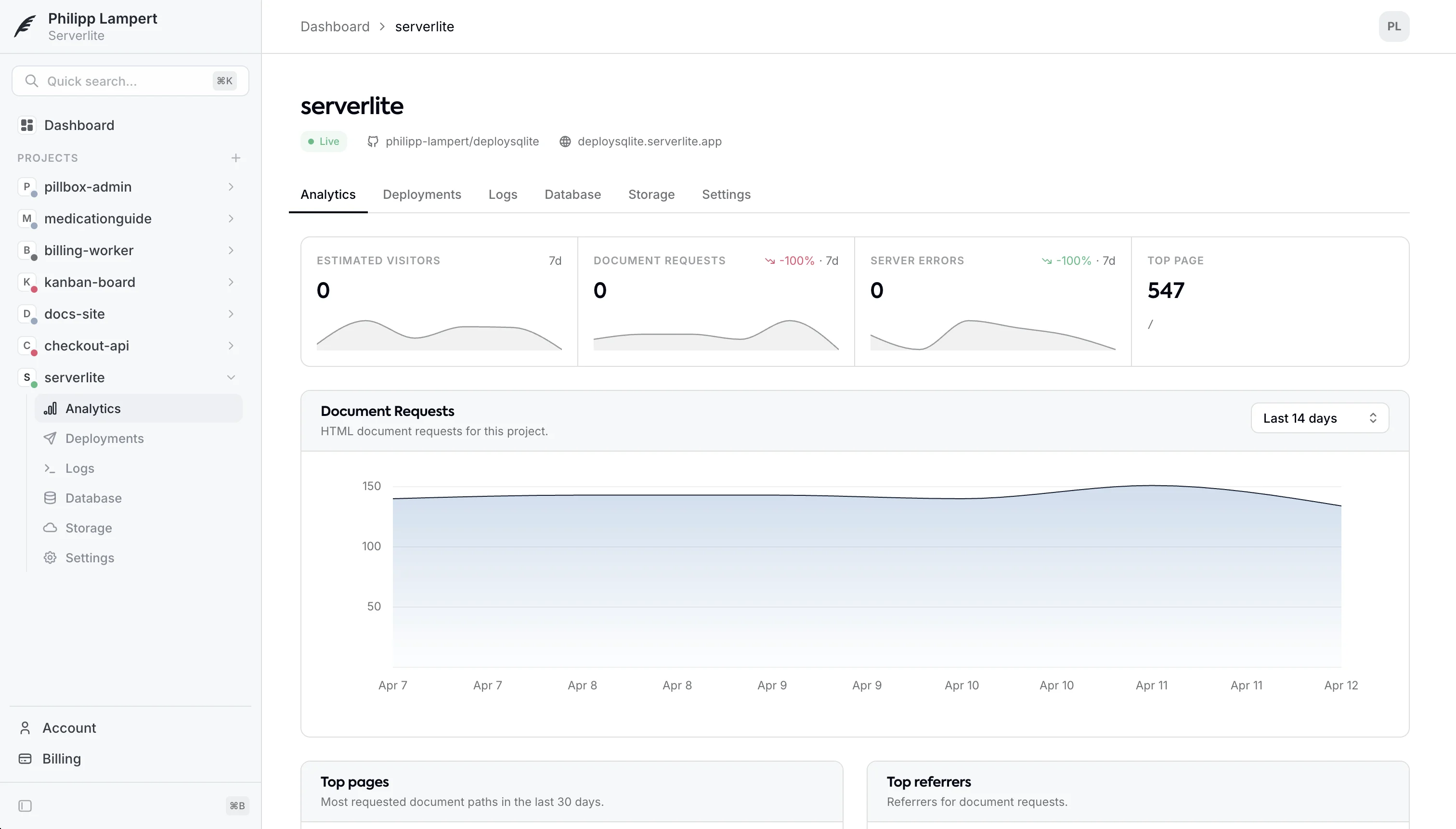
Built for stateful workloads
Most platforms assume stateless functions and remote databases. Serverlite runs SQLite on local disk, keeps the data volume attached across deploys, and supports the native runtimes your stack already depends on.
SQLite runs on the same host as the application, with WAL, transactions, extensions, and full ownership of the database file.
Deploy Node, Bun, Python, Ruby, or PHP alongside binaries like better-sqlite3, ffmpeg, ONNX, and Puppeteer. No serverless rewrite required.
Traffic cuts over only after the new release passes health checks. The `/data` volume stays attached, and SQLite streams continuously to object storage.
Designed for specific workloads
Serverlite is opinionated. It targets applications that benefit from a local database and a conventional server runtime, not every deployment model.
Good fit
Poor fit
Everything a stateful app needs, built in
SQLite on local disk
Same host as the application process. WAL, transactions, extensions, and direct ownership of the database file.
Native runtimes and binaries
Standard Node, Bun, Python, Ruby, and PHP runtimes. Ship better-sqlite3, ffmpeg, ONNX, OCR, and Puppeteer without workarounds.
Zero downtime stateful deploys
Traffic shifts only after the new release passes health checks. Persistent state stays attached throughout the rollout.
Continuous SQLite backup
SQLite changes stream continuously to durable object storage. Recovery is based on recent replicated state, not ad hoc snapshots.
Object storage per project
An S3 compatible bucket provisioned per project, with scoped credentials injected into the runtime environment.
Push to deploy
Connect a GitHub repository and push a branch. Build, deploy, migrate, and cut over run automatically.
How Serverlite compares
Serverless platforms push local state, writable disk, and native runtimes onto the customer. Serverlite includes them by default.
Fly.io now recommends Litestream after deprecating LiteFS. Serverlite ships that durability path by default rather than leaving it to the customer to assemble.
Deploy the architecture you already chose
Local state, native dependencies, and stateful rollouts. One production workflow.